
You Own Your Imagination
In Celebration of the Fifth Brain Collective's Third Birthday

In preparation for the third birthday of the Fifth Brain Collective, we wanted to remember the book that started it all.
Frankie Rollins spent a sabbatical writing this book. Writing this book made her fierce about how writing could be encouraged. Being that fierce made her brave. She threw in her academic towel to coach and lead writers into their own power in the Fifth Brain Collective.
Join us as we celebrate three magical, inspirational years of the Fifth Brain Collective, where each writer learns to honor their own brain and ideas first, above all others.
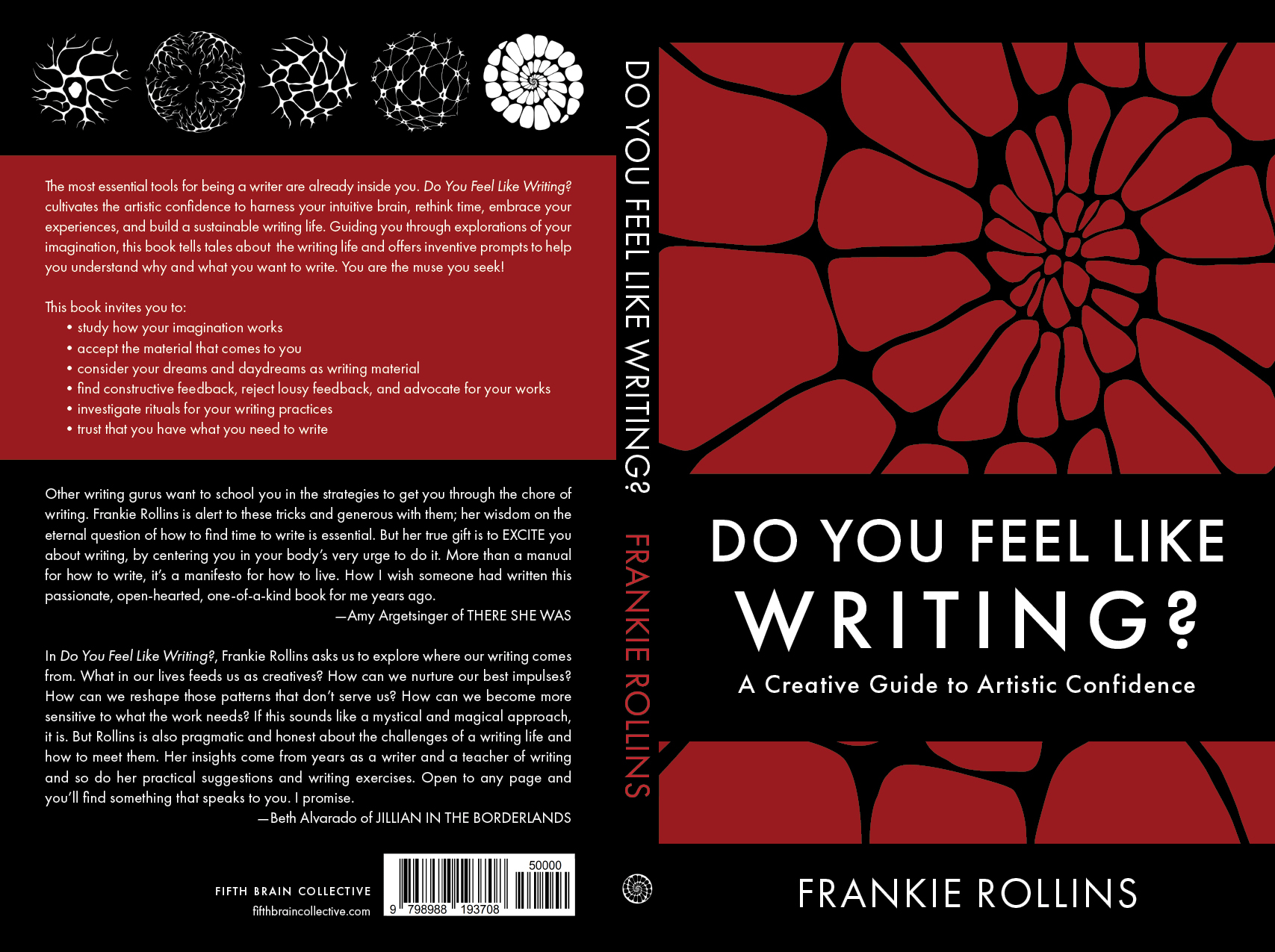
Here’s the opening excerpt from Frankie’s book, Do You Feel Like Writing? A Creative Guide to Artistic Confidence. We hope it will remind you of your own beautiful capacities.
”Once I was getting ready to move and I found a box full of tiny notebooks from my purses over the years. The notebooks were desiccated from pages torn out, ink-smeared, ratty, and dusty. I almost took the box over to a trash bag without looking inside any of the notebooks. There were handfuls of them with curled edges, a hundred different colors and shapes. They were so light; how could they contain anything meaningful? I opened one and started reading. Sentences snatched from conversations, character sketches, illegible notes scribbled in dark movie theaters. Fervent wishes, lines of poems, epiphanies. Grocery lists. Scraps of real moments translated into fiction. Phone numbers floating without names. What I was going to throw away, this trash, was gathered evidence of my writing mind, my imagination. What I was going to throw away was essentially mine, essentially me.
What evidence will you leave of your imaginative life, of your own particular brain?
One of the reasons we don’t inherently know whether to trash or treasure our ideas is because movies and books often portray an artistic person accessing a muse from outside of their body. This implies that the most amazing gifts for a writer come from the outside, rather than the inside. The idea of an outside muse implies that we have no control over our writing, can’t access it when we want to, or that we could even lose it. This isn’t so. Every writer has a part of their brain working for them during conscious and unconscious hours, gathering, sifting, and sorting. I call this meaning-maker the fifth brain. Your fifth brain belongs to you. It translates the juices of your observations, churns the connections, isolates the truth of what you want to say. It’s working inside of you right now. You are the muse you seek.
You may not know, consciously, where to go with an idea, how to write it. But way back there in your fifth brain, there is a little animal part of you formulating the work you need to, want to, must make. In Becoming a Writer, Dorothea Brande says writers should “hitch your unconscious mind to your writing arm.” Trusting the fifth brain is a way to do that, to trust that what rises in your mind is where you should begin. There’s no other factor. You can start there, with your first idea.
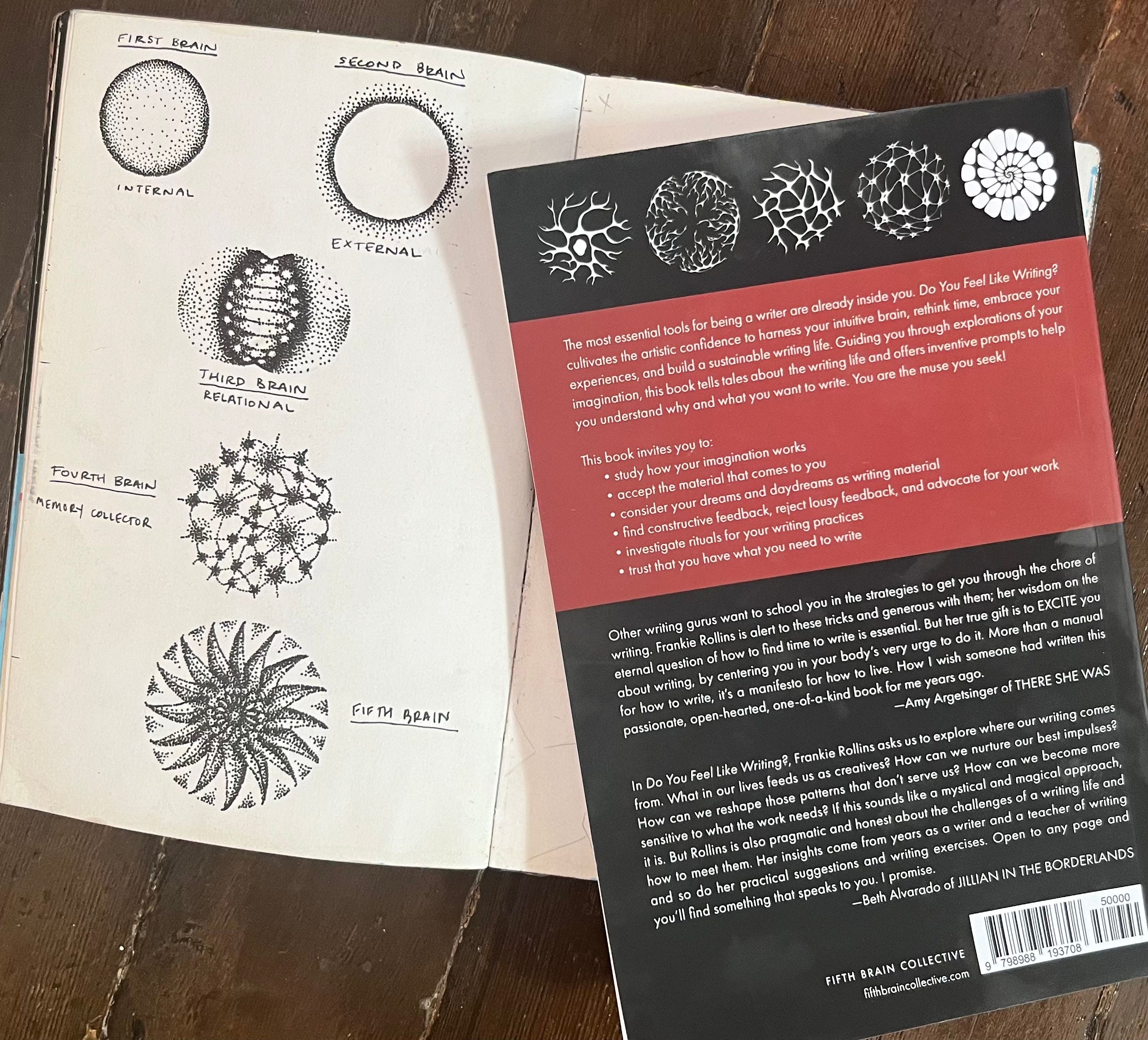
The fifth brain is a metaphor for ease of accessing imagination, harnessing material, and trusting in each writer’s singularity. The fifth brain works in the unconscious, making connections. When I came up with this metaphor, years ago teaching a creative writing class, I mentioned that a student might trust her fifth brain and was met with half a class of blank stares and half a class nodding and scribbling down a note. I stopped and offered a definition that I only barely understood at the time. I said that it seemed to me that a writer’s mind has several components, like a cow’s four-part ruminant stomach, each to do a separate part of the writing. (Regarding the biologically unsavory nature of this metaphor, I would note that food transforms into energy just as our brain’s intake of information transforms into the energy of ideas, similarly without thought.) We exist in a constant sea of internal emotions, settings, relationships, memories, and associations. The most crucial part of the brain, the fifth brain, is the one that synthesizes all these streams of information. These streams make up your imagination and it’s up to you to trust that your imagination is singular to you and that if you want to write, you have what you need to do so.
You have your own pattern of mind, created by your imagination and the knowledge you’ve gathered, and as a writer, it is your work to learn these patterns for your own writing pleasure. You can learn how to access your imagination at any time. You can learn to honor this ability like you would any sacrament, ones you make in marriage or parenting or as a doctor or warrior or activist or otherwise. You can carve out time for your art. You can commit to it.
Some writers are accomplished at blocking the fifth brain: over-intellectualizing, allowing real or imagined editors’ harsh critiques, dismissing fresh ideas as not-being-worthy, imagining your failure ahead of time. These struggles result in frustration for the writer. Instead of this fretting, you can trust that it’s important to write. You can get out of the way. There’s no work to reach the fifth brain. It’s already in there. All you have to do is start. Write a sentence about yearning. Write a sentence about something you see when you look up from this book. Write a sentence about one of your internal organs. . .
Writing takes some difficult skills, such as leaning in when you want to back away, confidence in the face of vulnerability, knowing how to experiment and trusting that you won’t die before you get a chance to revise. You’ll fail and in failing, develop a deeper intimacy with your writing. You can learn to love the writing more than a dream of success for the writing. You can learn that the act of writing is success. You can write a successful word, a sentence, an entire text. You can be proud of any part of your writing. Even one perfectly selected word can be successful. After all, this is all that writing is, one selected word after another. This pride can help you see where you want to take a text.
It can be embarrassing to be proud of something you’ve written. After all, what if later you decide it isn’t any good, or someone else says it isn’t any good? That’s okay. Love it in the moment. Just as you can’t love a friend or partner or a child based on their every action in every moment, you can let love for your writing build over time, in small moments and gestures. Writers must risk that love to finish writing something.”
Prompt:
What evidence will you leave of your imaginative life, of your own particular brain? Make of list of people you’ve affected. Things you’ve made. Writing. Dancing. Art. Moments you’ve shared. Anything that comes to mind. Keep going. Write more things. Let this list get broad and tall.
Trust that the ideas that come up are what you should pay attention to. Don’t question or belittle them. Write them down. We LOVE “humble brags” and don’t require them to be humble. Please put what you write in the chat. We’ll read every one and celebrate.
I started to memorize like the questions they were asking me to fill out and I did that and it was a great way to get some memories down things that I’ve forgotten and I started reading what you’re writing and I thought oh I need help. I need those prompts to fill out and then they’re gonna make it into a book. I should go back and try.
Lotta memories my children have no idea I did… except for the one child who told her preschool teacher that I was in jail🤣😂 that was a partial truth